

Explosion protection in silos, elevators and dusty processes – by design, documented
Flour dust, sugar dust, feed dust – these are not just production nuisances but explosive materials handled under standards. ATEX compliance in the food industry is not optional: it's an authority and insurer requirement.
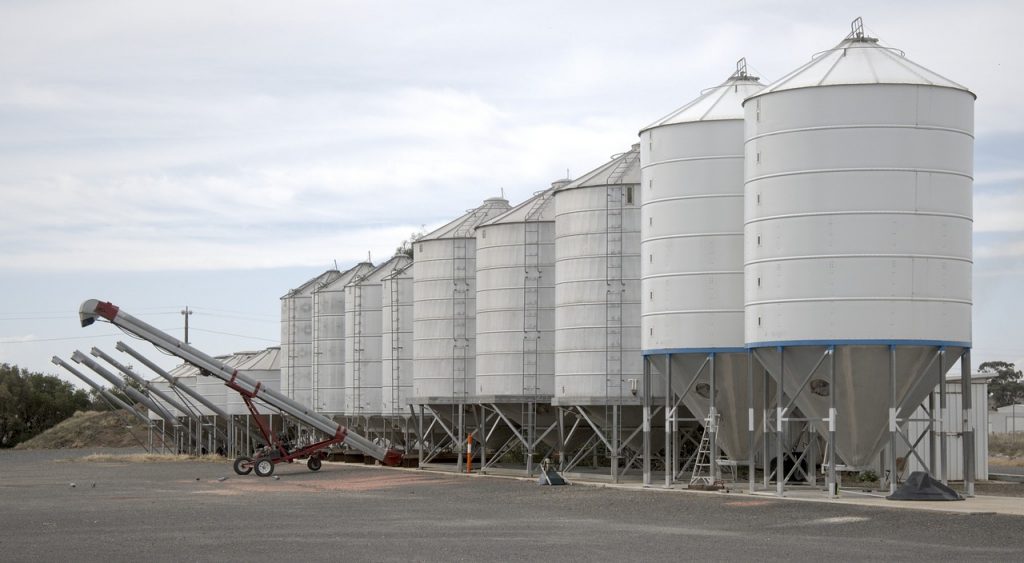
Why is dusty food-industry ATEX a special challenge?
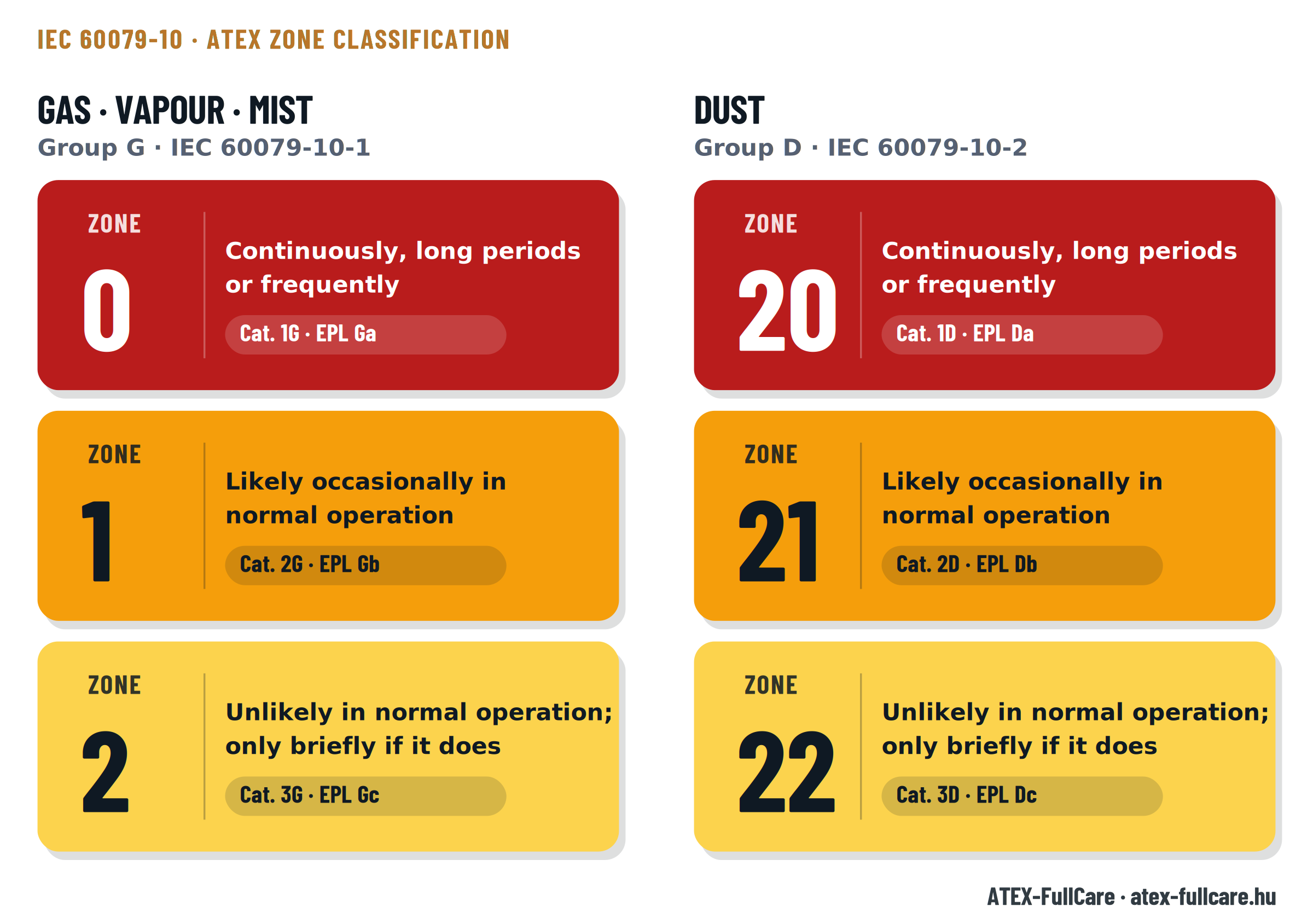
The rules, zones and equipment markings for gas (G) and dust (D) explosion protection differ fundamentally. Yet many plants apply them incorrectly – often installing gas-marked devices in dust zones.
Deposited dust can ignite too
Per IEC 60079-10-2, dust is hazardous not only as a cloud but also as a deposited layer. The T-class (max. surface temperature) must be matched to the ignition temperature of the dust – often a surprisingly low value.
Dust groups are critical
IIIA (flyings), IIIB (non-conductive dust) and IIIC (conductive dust) require different equipment markings. Flour dust is typically IIIB; metal-containing feed additives may fall into IIIC. Getting the dust group wrong is a direct breach.
Static charge in pneumatic systems
Dust pumped or conveyed into a silo picks up electrostatic charge through friction. Without proper equipotential bonding (EPH) and earthing a spark can form – enough to ignite a dust cloud.
Dust ingress (IP rating) is decisive
In dust zones, the Ex t (enclosure protection) method requires IP6X on the primary enclosure. If this is compromised – e.g. after a modification or repair – the whole protection concept may be void. This needs regular visual inspection.
Typical facilities and expected zones
The table below is indicative. Actual zone boundaries must always be determined by an on-site survey and a documented risk assessment per IEC 60079-10-2.
| Facility / equipment | Typical material | Interior | Filling / discharge point | Surrounding area |
|---|---|---|---|---|
| Grain & feed silo | Grain dust, feed dust | 20 | 21 | 22 |
| Bucket elevator | Various granular materials | 20 | 21 | 22 |
| Bag filter / cyclone | Flour dust, sugar dust | 20 | 21 | 22 |
| Mill, grinder, crusher | Flour, sugar, grain dust | 20 | 21 | 22 |
| Bagging & packaging machine | Flour dust, sugar, spices | – | 21 | 22 |
| Pneumatic conveying system | Dust, granulate | 20 | 21 | 22 |
| Conveyor belt (covered) | Grain, feed | – | 21 | 22 |
| Mixer, granulator | Compound feed | 21 | 21 | 22 |
Dust groups: IIIA (combustible flyings), IIIB (non-conductive dust – e.g. flour, sugar), IIIC (conductive dust). Actual classification depends on laboratory data and site conditions.
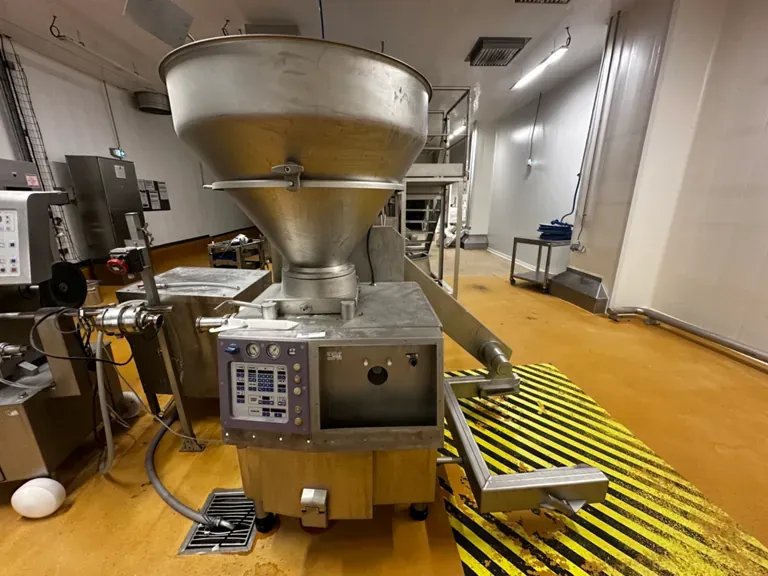
Not just on paper – on the floor too
Around a filling or dosing machine the zone boundaries appear in practice as well: floor marking (yellow-black), the classified area around the machine and cleanability (hygienic design) together determine the required Ex protection, dust-tightness and T-class. The on-site survey captures the real situation – not the theoretical drawing.
What is mandatory – not optional
If flour, sugar, grain or other combustible dust can be present, the employer must assess the possibility of an explosive atmosphere forming. If it can, Decree 3/2003 applies.
Explosion protection risk assessment
Must be carried out before first commissioning and updated on every process change. Basis: Decree 3/2003 (III. 11.) FMM–ESzCsM.
Zone classification & zone map
Hazardous areas must be classified (zones 20/21/22) and recorded in documented drawing form per IEC 60079-10-2.
Explosion Protection Document (EPD)
The mandatory base document summarising zone classification, action plan, equipment conformity and operating rules. It can be requested at any inspection.
Suitable Ex equipment
Equipment of the right category (1D/2D/3D), correct dust group and T-class, with valid certificates, must be installed.
Periodic inspection
Per IEC 60079-17: annual visual and detailed inspection every 3–5 years, with a photo-documented report and a prioritised defect list.
Worker training
Workers in hazardous areas must be trained regularly. The training and the fact that it took place must be documented.
How does ATEX-FullCare help food & feed plants?
We work not as an inspecting authority but as an engineering partner. The goal: genuinely workable, sustainable ATEX compliance – at a predictable cost.
01On-site survey & zone classification
Walk-through of silos, elevators, filters and machines. Identification of dust and gas hazard points. Zone boundaries and drawing documentation per IEC 60079-10-2.
02Explosion Protection Document (EPD)
Preparing a new EPD or updating an existing one. Zone map, ignition-source analysis, operating and work rules, training syllabus.
03Ex equipment & dust-tightness check
T-class conformity, dust-group check, IP6X dust-tightness review. Certificate audit, glands and stopping plugs check.
04Static-charge protection
Design of equipotential bonding (EPH) and earthing. Handling of pneumatic conveying systems, filling pipes and bags.
05Periodic ATEX inspection
Visual, close and detailed inspection per IEC 60079-17. Photo-documented report in English or Hungarian, with a prioritised defect list.
06ATEX training for operators & maintenance
Targeted training on the plant's specific zones and equipment. Basic and advanced levels, for both EHS and maintenance teams.
Typical ATEX faults in food & feed plants
These problems are not only breaches – they carry real accident risk, and trigger immediate action at an inspection.
Gas-marked device in a dust zone
An Ex d or Ex e motor or switch cabinet designed for gas is not suitable in a 20/21/22 zone – it lacks the required dust-tightness and dust-group conformity.
Incorrect T-class determination
The ignition temperature of dust (e.g. flour ~360–430 °C, sugar dust ~350 °C) can be lower than expected. The equipment surface temperature must stay below it with a safety factor.
Damaged or unsuitable IP dust-tightness
A poorly refitted seal, a missing stopping plug or an unsuitable gland after a repair or modification can all invalidate the Ex protection method.
Outdated or incomplete EPD
The most common problem: the EPD was made 5–10 years ago, since then there have been extensions, machine changes, technology changes – but the documentation did not follow.
Missing EPH and earthing documentation
Equipotential bonding (against static charge) is in many places only partially implemented and documented, or not at all.
No documented operator training
Workers know the operating rules, but the fact that training took place is recorded nowhere. At an inspection this immediately appears as a deficiency.
FAQ – food & feed industry ATEX
Do flour and sugar dust fall under ATEX?
Yes, clearly. Flour and sugar dust are combustible and, at the right concentration, can form an explosive dust cloud. Both fall into the ATEX dust (D) zone category, and under Decree 3/2003 the employer must carry out a risk assessment and, if needed, prepare explosion protection documentation (EPD).
Is ATEX documentation mandatory for a silo?
Yes. A silo interior is typically classified as zone 20 (continuous or long-lasting dust cloud), and the area around the filling/discharge point as zone 21. These require mandatory documentation, suitable Ex equipment and periodic inspection. The authority can request the EPD and zone map at an inspection.
What's the difference between zones 20, 21 and 22?
In zone 20 an explosive dust cloud is present continuously or for long periods (e.g. silo interior, bag-filter interior). In zone 21 a dust cloud is likely in normal operation (e.g. filling point, near an elevator). In zone 22 a dust cloud may occur only under abnormal conditions, rarely and briefly (e.g. wider area around a conveyor). Each zone requires a different equipment category: 1D, 2D and 3D respectively.
When must the EPD be updated?
It must be updated when new technology or equipment is installed, an existing system is modified, the material changes (e.g. a different dust is used) or a new production line starts. It is recommended to review it regularly, at least every three years. The most common mistake: the EPD was made years ago and has not tracked the actual changes.
Pneumatic conveying system – which zone does it fall under?
The interior of a closed pneumatic pipe system is generally zone 20, since a dust cloud is continuously present during conveying. Connection points, relief valves and dosers are typically zone 21, and the wider process area can be zone 22. Static charge is especially critical: friction between the dust and the pipe creates electrostatic charge that must be managed with proper EPH and earthing.
When is periodic ATEX inspection mandatory?
Per IEC 60079-17 the type and frequency are risk-based: typically an annual visual check, a close inspection every two years, and a detailed inspection involving disassembly every 3–5 years. The exact schedule is determined together by the plant's risk level, the protection methods used and the operating conditions (dust quantity, moisture, chemical exposure).
Do you have dusty technology on site? Let's start with a free assessment.
In a 30–60 minute online discussion we go through the type of site, the current documentation status, and clarify exactly what is needed – and what is not.
- CompEx certified ATEX expert
- 25+ years of industrial experience (offshore, onshore, chemical)
- Both gas (G) and dust (D) media
- Photo-documented report in English or Hungarian
- Itemised, transparent quote – no surprises
- The discussion is free and without obligation