

Explosion Protection Document (EPD) preparation and update — before an inspection, audit or process change forces it
I prepare and update explosion protection documents for industrial sites so they are not just paperwork, but a usable engineering decision base: hazardous area classification, risks, gaps and concrete action recommendations. In three packages — each one compliant, you choose the depth.
To start, a short description, a few photos, an existing document or a layout drawing is enough.
What does the law require?
An EPD is not optional: it is required by Section 9 of Decree 3/2003 (III. 11.) FMM–ESzCsM and Section 99 of the National Fire Protection Code (OTSZ, Decree 54/2014 BM), within the framework of the Occupational Safety Act (Act XCIII of 1993), following the methodology of Fire Protection Technical Guideline TvMI 13. The hazardous area classification is prepared to the current EN IEC 60079-10-1:2021 (gas) and EN 60079-10-2 (dust) standards.
Detailed guide – mandatory content, validity, who can prepare it and how much it costs: Explosion protection document – regulations, content, cost.
When is it worth ordering now?
This page is not about general ATEX training. It is useful if you specifically need to get the explosion protection documentation in order at your site.
No EPD, but explosion risk may exist
Flammable gas, solvent, dust, flour, granulate, paint, or an alcohol- or solvent-based technology appears at the site.
Old or outdated documentation
The technology, layout, machinery, ventilation, storage or workflow is no longer what the old documentation shows.
Audit, customer or authority inspection expected
You don't want to explain afterwards, in a hurry, why there is no up-to-date zone classification or action plan.
The biggest risk is not the lack of a nice-looking document
It is that the documentation is not in line with reality.
Typical problem
There is some old EPD, but meanwhile the technology changed, new machines were added, ventilation was modified, material storage moved, or the zone drawing no longer matches the actual site.
How I help
- We check whether the existing documentation is usable.
- We identify where the paper and the real state diverge.
- We determine whether an update, an addition or a new EPD is needed.
- We don't just list the issues – we prioritise them.
- The goal: documentation that is auditable, defensible and usable in operation.
Hazardous area classification – the basis of every EPD
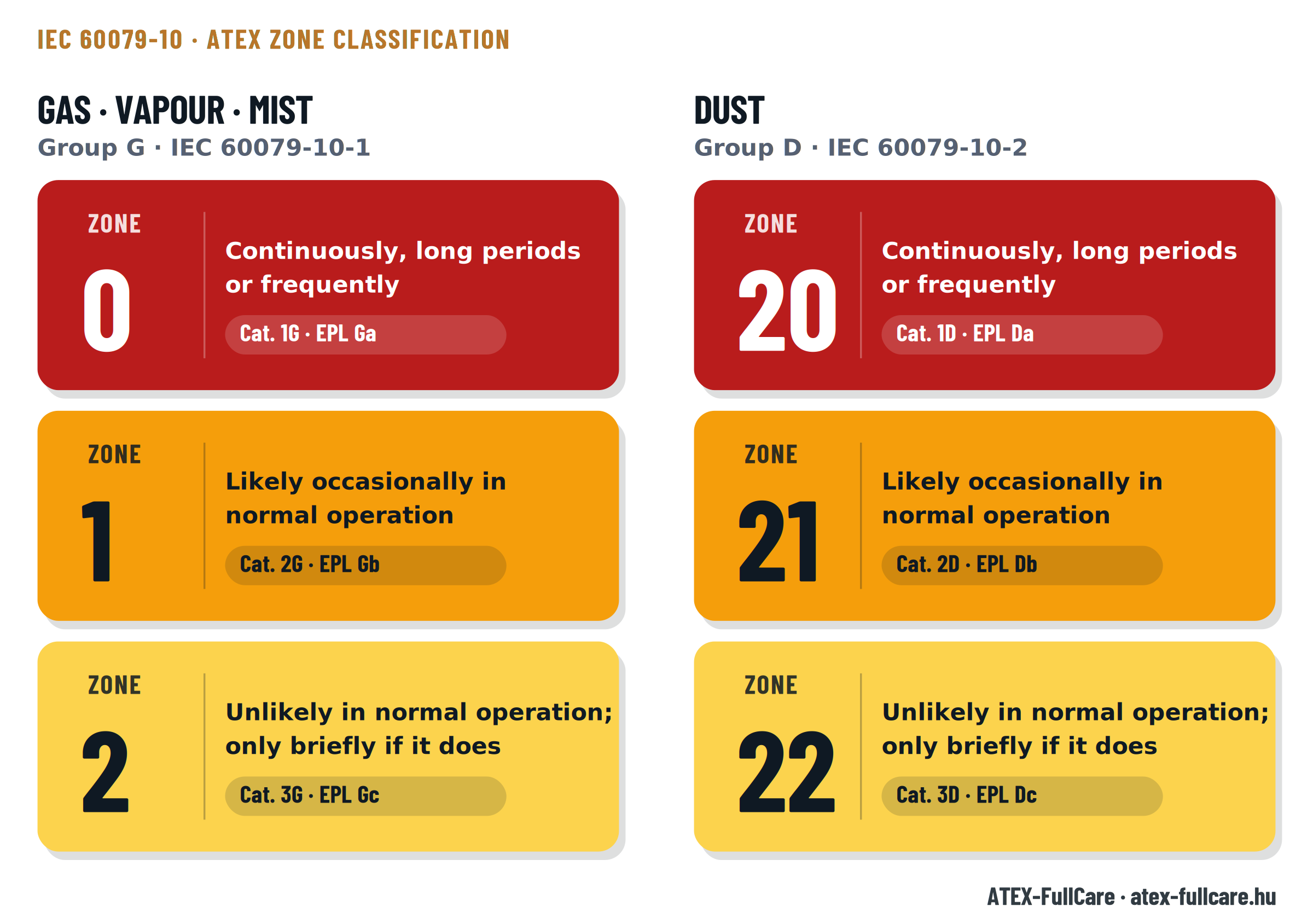
An explosion protection document stands or falls on the hazardous area classification: where, how often and for how long an explosive atmosphere can be present. This determines the required zones, the equipment category and the protection level (EPL).
Choose the right depth
Every package delivers a complete explosion protection document compliant with Directive 1999/92/EC and IEC 60079-10-1. The difference is not compliance – it is how we get there: conservative classification or measurement and calculation, sampling or item-by-item survey. You choose; in every case we state what you get and what remains your responsibility.
ATEX Compliance
Compliant documentation – fast, with clear responsibilities.
For: simpler, well-mapped technology where fast legal compliance is the goal right now.
ATEX Verified
Measured, verified zones – where zone size costs money.
For: most operating plants – where zone size drives equipment and operating cost, or change/an audit is coming.
ATEX FullCare 360
Minimal zones, a complete register, a system that keeps you compliant.
For: complex or multi-site plants, before a major investment/audit.
A large, conservatively classified zone full of non-Ex equipment? A verified zone reduction can avoid the costly equipment replacement.
For the technical decision – the business takeaway is above, in the cards and the summary.
| ATEX Compliance | ATEX Verified · Recommended | ATEX FullCare 360 | |
|---|---|---|---|
| On-site sessions | 1–5 days* | typically up to ~10 days* | depends on site size, individually* |
| Zone classification | conservative, without measurement (larger zones) | calculated for the governing sources, ventilation measured | full calculation for all sources, minimal verified zones |
| Measurements | – | air-flow measurement, smoke test | + multi-point measurement, gas detection, 3D survey |
| Zone map | drawn on your PDF layout | your existing zone map reused and validated, or a new zone map we prepare – delivered as PDF | as Verified, from the 3D / point-cloud survey; in an editable format (AutoCAD DXF), not only PDF |
| Ex equipment register | ~10 % sample | 20–30 % itemised | 100 % itemised (photo, marking, suitability) |
| Defect list | deviations seen on the walkdown | itemised, with standard references | complete, prioritised with suggested deadlines |
| Risk assessment | process level | source level | equipment / ignition-source level |
| Recommendations | advisory | written recommendations | drawn implementation proposals, tender-support option |
| Operational support | operator task list with deadlines | operator tasks + the measured/validated conditions recorded, so the smaller zone stays valid | EN 60079-17 inspection regime, checklists and procedures; ongoing follow-up option |
| For whom | simpler, well-mapped technology where fast legal compliance is the goal (not reducing zones) | most operating plants: where zone size drives equipment and operating cost, or expansion, change or an audit is expected | complex or multi-site plants, before a major investment or audit, with a complete register and ongoing compliance; and where non-Ex equipment already runs inside a large, conservative zone and a verified zone reduction can avoid replacing it |
* The number of on-site days depends on the size and complexity of the site – the exact effort is set in the individual quote after the needs assessment.
We don't put a fixed price on the website – every plant is different. The exact fee is in an individual quote after the free needs assessment. Credit: the Compliance fee is credited toward Verified within 12 months, and Verified toward FullCare 360.
A simple, transparent process
We don't start with long consulting rounds, but with quickly finding out exactly what needs to be put right.
Short needs assessment
You send the basics: site type, technology, hazardous materials, existing documents, drawings, photos.
Preliminary technical direction
I check whether it is an update, a new document, a zone-classification problem or an inspection question.
On-site survey
Checking the real technological state, ventilation, storage, ignition sources, Ex equipment and workflows.
Documentation proposal
A written summary of what is adequate, what is missing, what must be corrected, and what further documentation is needed.
EPD preparation or update
If needed, based on a separate quote, the full explosion protection document, zone drawing and action plan are prepared.
Why ATEX-FullCare?
I don't just deliver a document, but an engineering approach: I review explosion-protection compliance from the electrical, HVAC, technological and operational sides too.
Industrial experience
More than 25 years of electrical and HVAC experience, a significant part in oil, gas and industrial environments.
Practical approach
I look not only at what the document says, but at how the plant actually operates.
Management decision base
The result is not just a technical file, but an understandable priority list: what to fix now, what can be sorted later.
Do you want the EPD documentation quote?
Briefly describe the site location, the medium (gas or dust), what you need a quote for (preparatory consultation / hazardous area classification + EPD / periodic inspection) and the desired deadline. Based on this I will get back to you on which package (Compliance, Verified or FullCare 360) fits the situation.
Useful to send in advance: layout drawing, technology description, hazardous-materials list, safety data sheets, old EPD, zone drawing, Ex equipment list, photos, audit notes or authority remarks.
Frequently asked questions
Do all three packages comply with the law?
Yes. All three packages meet the content requirements of Decree 3/2003 (III. 11.) FMM–ESzCsM and Directive 1999/92/EC; the difference is the method and the depth of evidence.
Why are the zones larger in the Compliance package?
Because we don't build on what we don't measure: under EN IEC 60079-10-1, unverified ventilation counts as poor availability, so the zone becomes stricter (larger). Measurement and calculation can shrink the zone – that is Verified and FullCare 360.
What remains the operator's responsibility?
Maintaining the operating conditions described in the documentation, the initial and periodic inspections to EN 60079-17, and verifying the suitability of equipment not itemised – we record these with deadlines in every package.
What if there is more equipment than we estimated?
Equipment beyond the quantity included in the package is added at a unit rate – the uncertainty is not your risk.
Can I upgrade to a bigger package later?
Yes. Within 12 months the smaller package fee is credited toward the bigger one: Compliance toward Verified, and Verified toward FullCare 360.
Can it be surveyed during operation?
Yes; measurements that require a shutdown are aligned to the shutdown window, and weekend or shutdown work is flagged in advance.
What if we already have an explosion protection document?
This is common. In that case I check whether the existing documentation is up to date, in line with the technology, and whether an update is enough or a new documentation structure is needed.
Do you only help with electrical ATEX questions?
No. Besides electrical and Ex equipment, I also consider the technological state, ventilation, storage, earthing, equipotential bonding, workflows and operating rules.
Which documents are worth sending in advance?
A layout drawing, technology description, hazardous-materials list, safety data sheets, old EPD, zone drawing, Ex equipment list, photos, audit notes or authority remarks can all be useful.
Do you work nationwide?
Yes. ATEX-FullCare is based in the Kecskemet / Bacs-Kiskun region of Hungary; for industrial projects on-site surveys and documentation work are available nationwide, and internationally on request.