

ATEX inspection for industrial facilities – zone classification, EPD and field compliance
A targeted ATEX condition assessment for facilities where flammable gas, vapour, solvent, mist or dust may be present. The goal is not just to review documents, but to reveal whether the explosion protection, the technology, the Ex equipment and the on-site reality are actually in line.

When is it worth requesting an ATEX inspection?
- There is no up-to-date explosion-protection documentation or EPD.
- The technology, machinery, raw material, extraction or storage method has changed.
- A customer, insurer, internal or official audit is approaching.
- It's unclear whether the zone classification and the field reality are in line.
- A quick management decision is needed on the real level of explosion risk.
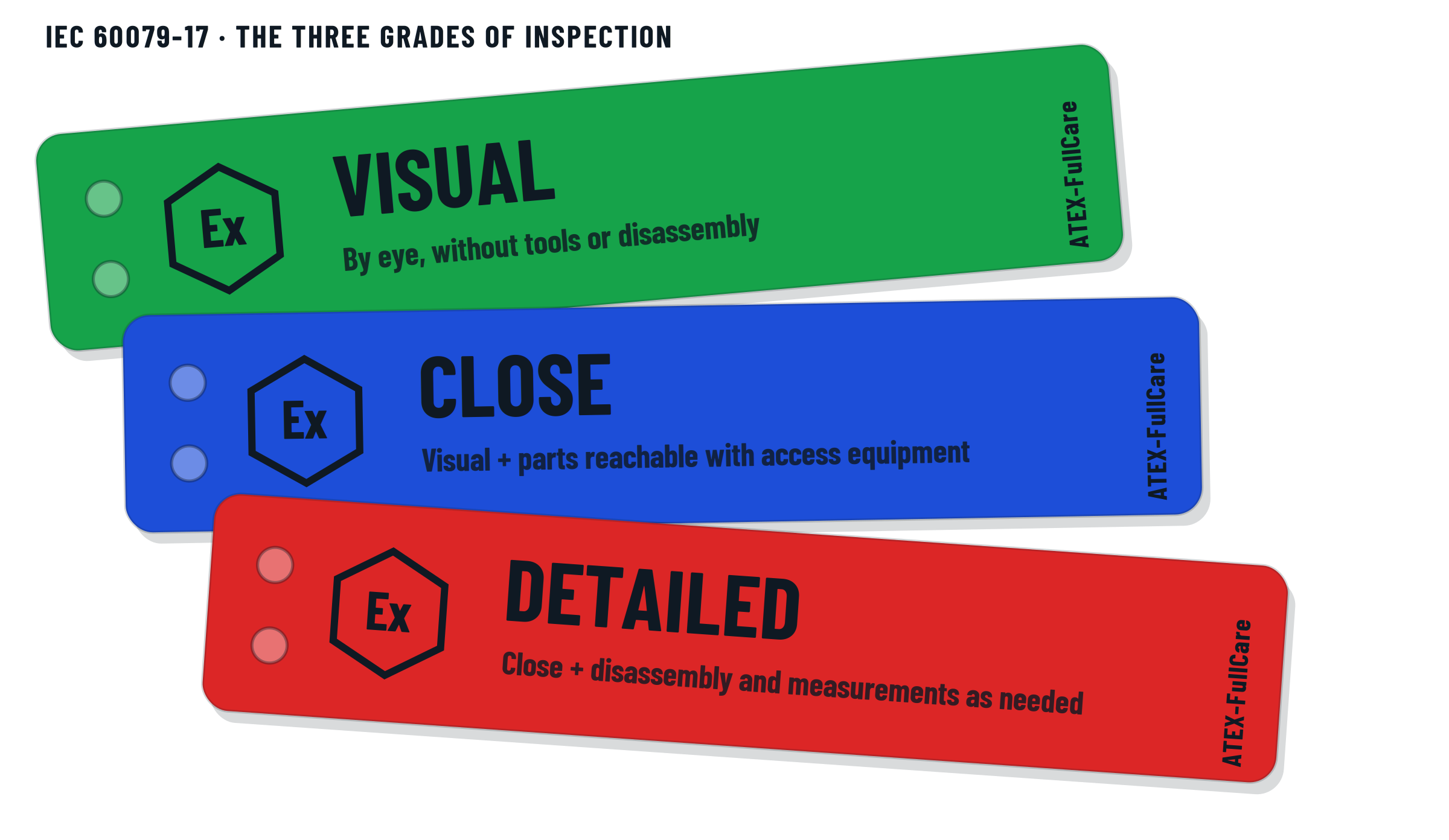
The three grades of inspection (IEC 60079-17)
The standard distinguishes three increasingly thorough inspection grades. The depth of the assessment is always driven by the task at hand and the level of risk.
You may not need to start with a full new document
In many facilities the first question is not whether a full new ATEX document should be produced immediately, but rather how defensible the current state is, where the most urgent gaps are, and what next steps are genuinely needed.
1. We look at the current state
We review the available documentation, the main process risks and the field condition.
2. We surface the key gaps
We highlight where documentation, zone classification, Ex equipment and the actual layout may diverge.
3. We recommend the next step
It becomes clear whether a minor correction, a document update, or more detailed engineering work is needed.
Who is it for?
Useful for company and plant managers, technical managers, EHS / HSE leads, occupational- and fire-safety professionals where flammable material may be present and who want to see how defensible their ATEX state is.
Typical industries
What does an ATEX inspection help with?
Zone classification
Is the current zone classification correct and professionally defensible? Does it follow the present technology, material use and release points?
Documentation vs. reality
Do the existing EPD, zone map and drawings match the field reality, or do they reflect an older state?
Technical protection
Do ventilation, detection, earthing, equipotential bonding, Ex equipment selection and the maintenance system work logically and consistently?
What can the ATEX condition assessment include?
Documentation review
- Review of the existing EPD or related documentation
- Review of zone maps, process drawings and descriptions
- Sample check of Ex equipment documentation
- Review of earlier inspections and reports
On-site survey & gap finding
- Identifying release points and main risk areas
- Sample-based check of equipment and installation solutions
- Surfacing obvious deviations and typical faults
- Prioritised engineering summary
Suggested service packages
The packages below show an indicative structure and price range; the prices shown are net amounts. The final quote depends on the size of the facility, the complexity of the technology, the level of documentation and the desired detail.
Online ATEX consultation
Entry-level overview for a smaller, well-defined question.
- Online or phone discussion
- Targeted review of existing documents, photos or drawings
- Summary of main risks and warning points
- A good basis for a first decision or next step
ATEX on-site condition assessment
For a smaller or well-defined industrial task.
- Preliminary online or phone discussion
- Up to 4 hours of on-site survey
- Typically 1–2 processes / technology units reviewed
- Targeted comparison of existing documentation and field state
- Substantial back-office engineering evaluation and structuring of findings
- Written ATEX condition-assessment summary (typically within 15–30 working days)
- Travel within Hungary included in the price
Detailed ATEX compliance review
For more complex technology, multiple zones, a larger site or a more detailed documentation need.
- More detailed review of zone classification and EPD
- Sample-based or extended on-site check
- More detailed surfacing of gaps and deviations
- Technical and documentation action proposals
- Preparation of implementation / field technical support
How does the work happen?
Short discussion
We go through the technology, the main risk points, and whether an online review, an on-site survey or more detailed support is needed.
Preliminary document review
Based on the available drawings, descriptions, photos, EPD or zone maps, I prepare the assessment.
Online or on-site survey
Depending on the need, a targeted online consultation or an on-site walk-through and survey takes place.
Engineering evaluation & recommendation
I hand over the ATEX condition-assessment summary with the main findings, gaps, risks and recommended next steps, prioritised where possible (typically within 15–30 working days).
Typical gaps I often come across
- Completely missing ATEX or EPD documentation
- Old or no-longer-current explosion-protection documentation
- Inspection missed after a technology change
- Unclear or overly general zone classification
- Mismatch between documentation and field state
- Incorrectly selected or applied Ex equipment
- Incomplete earthing or equipotential-bonding solutions
- Insufficiently considered ventilation or extraction logic
- Missing or inadequate detection solutions
- Unclear responsibility and maintenance system
Why ATEX-FullCare?
Practical engineering mindset
I consider not just the paperwork but the field layout, the equipment and the operating environment – with an electrical and mechanical maintenance background.
A summary usable for management
The result is understandable at management level too: what must be handled immediately, and what can be scheduled.
Gradual, sensible progress
You don't always need to think in terms of a big project right away. The first assessment helps decide how much work is genuinely justified.
Request a preliminary ATEX quote
Briefly describe the technology, material or equipment involved, whether there is an existing EPD or zone map, and why the inspection has come up now. Based on this I'll let you know whether an introductory on-site assessment may be enough or a more detailed quote is needed. Helpful to include: site / city, the technology involved, the type of flammable material, the state of existing documentation and the urgency.
Based on the information submitted, I'll indicate in advance what service level may be justified. The final scope and fee are always determined through individual consultation.
Frequently asked questions
Do you always have to start with a full new explosion-protection document?
No. In many cases a targeted condition assessment or gap analysis first gives the best basis for seeing whether an update is enough or a more complete document is genuinely needed.
Can we start online only?
Yes. For some tasks a first online discussion and document review already helps a lot in clarifying the situation before any more detailed on-site work.
What is the on-site package starting from HUF 610,000?
It is an introductory on-site condition-assessment package for a smaller or well-defined task (typically 1–2 processes or technology units). It includes a preliminary discussion, up to 4 hours of on-site survey, substantial back-office engineering evaluation, a written summary and travel within Hungary. The final price depends on the complexity of the task and the on-site conditions.
Are the prices shown fixed?
No. These are indicative price ranges. The final quote depends on the complexity of the task, the size of the site, the level of documentation, the travel distance and the desired level of detail.
What happens if a larger task appears after the first assessment?
Then a separate quote can be prepared for further engineering support, more detailed design, document updates, or field technical support for remedying the gaps found. On request, ad-hoc support, project-based involvement or a monthly–quarterly framework agreement can also be arranged.