

ATEX zones explained – gas and dust zone classification
A zone tells you how often and for how long an explosive atmosphere is present in a given location. This determines which category of Ex equipment may be used there. Here I lay out the gas and dust zones clearly, with examples.
What is a zone, and why does it matter?
Zone classification categorises locations by the frequency and duration of the explosive atmosphere. There is a separate system for gas/vapour (IEC 60079-10-1) and for dust (IEC 60079-10-2). The classification determines which equipment category and EPL must be selected for a given location – which you can read from the markings.
Gas zones – 0, 1, 2
| Zone | Description | Example | Category · EPL |
|---|---|---|---|
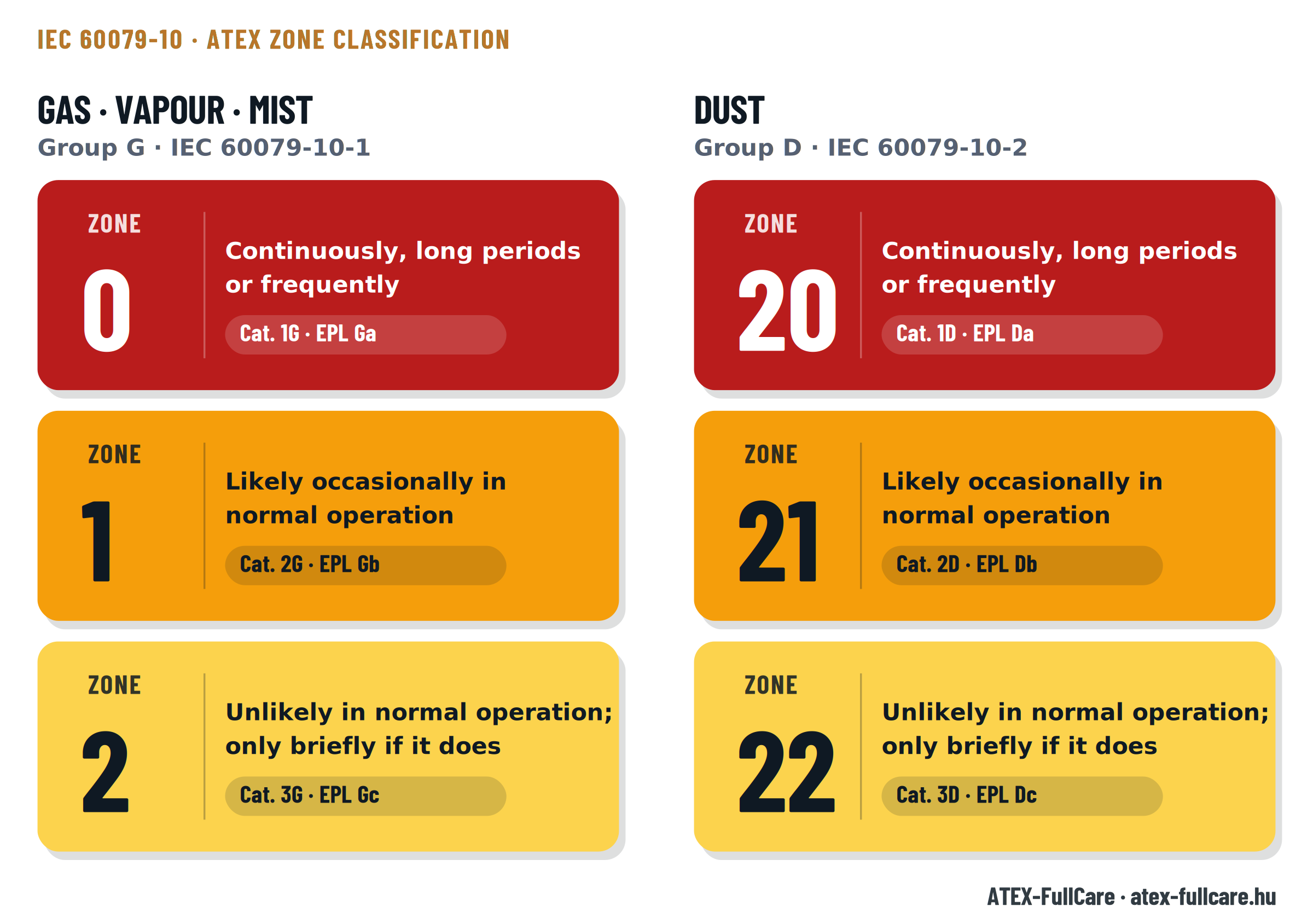
| 0 | Gas mixture present continuously or for long periods | Inside a vessel | 1G · Ga |
| 1 | Likely to occur in normal operation | Around a filling point | 2G · Gb |
| 2 | Rare and short-term occurrence | Valves, flanges | 3G · Gc |
Dust zones – 20, 21, 22
| Zone | Description | Example | Category · EPL |
|---|---|---|---|
| 20 | Continuous / long-lasting dust cloud | Inside a silo, cyclone | 1D · Da |
| 21 | Dust cloud occurring frequently | Packing, discharge point | 2D · Db |
| 22 | Transient dust cloud | Around a conveyor belt | 3D · Dc |
Gas and dust zones at a glance
Need an accurate zone classification?
Zone boundaries are determined through ventilation and release-source analysis. Request a free 30–60 minute online assessment and we’ll go through the substances and areas at your site.