

ATEX zone classification – gas and dust zones
Zone classification is the foundation of ATEX compliance – it defines where and how likely an explosive atmosphere can form. Gas (0/1/2) and dust (20/21/22) zones, with ventilation calculation, a zone map, as an EPD annex.
Why is zone classification the cornerstone of ATEX compliance?
Zone classification defines how likely and for how long an explosive atmosphere can occur in a given area. This is the basis for every further ATEX decision: what equipment is required, what work rules apply, and what must be documented.
Without zone classification there is no valid EPD – and you cannot correctly select Ex equipment. If the zone classification is wrong, the whole ATEX system stands on a flawed foundation.
Gas (G) and dust (D) zones
Gas and dust explosion protection use different zone numbering and require different equipment categories. Each zone is defined by the frequency and duration of the explosive atmosphere.
🔥 Gas/vapour zones (G)
Continuously or for long periods present explosive gas mixture. E.g. interior of a tank or closed vessel.
Likely in normal operation. E.g. filling point, area around a pump.
Occurs rarely and briefly. E.g. around valves and flanges.
💨 Dust zones (D)
Continuously or for long periods present combustible dust cloud. E.g. silo interior, cyclone.
Likely in normal operation. E.g. packaging, filling point, filter.
Forms rarely and briefly. E.g. around a conveyor, in storage.
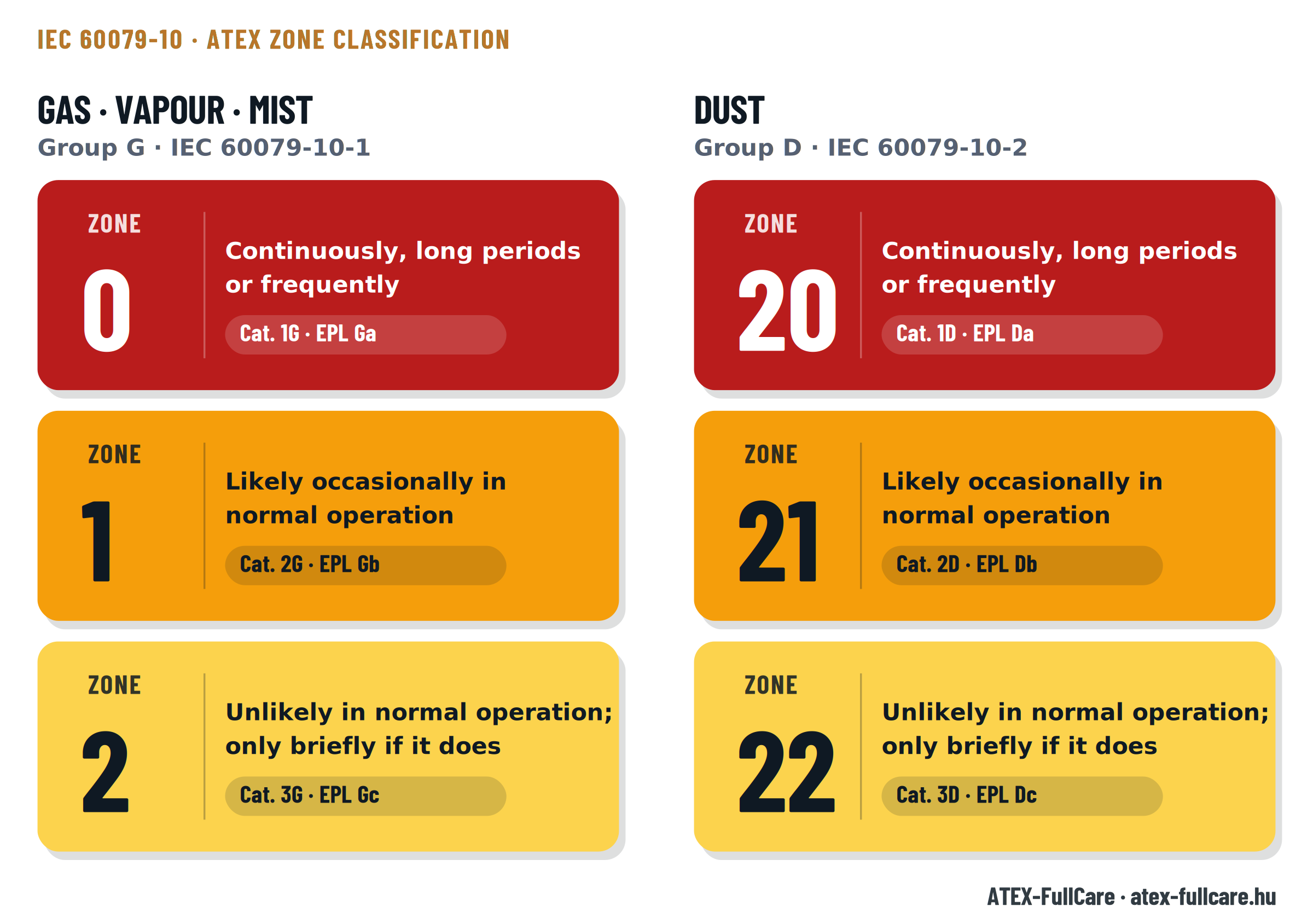
The zones at a glance – category and EPL
Zone classification determines the required equipment category and protection level (EPL). The graphic below summarises gas and dust zones, their severity and the corresponding categories per IEC 60079-10.
How is zone classification done in practice?
Zone classification is not guesswork – it must be carried out per IEC 60079-10-1 (gas) and IEC 60079-10-2 (dust) with ventilation calculation, source identification and extent determination.
Source-of-release identification
Identifying every source of flammable material: storage, handling, process steps, leak points. Determining material properties (flash point, LEL, gas/dust group).
Ventilation calculation
Based on ventilation quality (high/medium/low), release rate of the source and room geometry, we determine the expected concentration and the extent of the zone.
Zone-map preparation
Drawing documentation of the zones on layouts and, where needed, sections. Showing the type and extent of each zone and the equipment category to apply.
EPD annex
Zone classification and the zone map are a mandatory annex of the EPD. It also contains the justification of zone boundaries and the relevant material data.
Which standard applies to zone classification?
| Standard | Scope | Application |
|---|---|---|
| IEC 60079-10-1 | Flammable gases and vapours | Gas/vapour zone classification (0/1/2) |
| IEC 60079-10-2 | Combustible dusts | Dust zone classification (20/21/22) |
| IEC 60079-14 | Design of electrical installations | Equipment selection by zone |
| IEC 60079-17 | Periodic inspection | Inspection of Ex equipment |
| Decree 3/2003 (HU) | Hungarian regulation | Mandatory EPD, zone classification |
Most common zone-classification mistakes
- No drawing-based zone classification – only described in text in the EPD.
- The extent of the zone is not supported by calculation, only by estimation.
- After a ventilation change the zone classification was not updated.
- Dust zone classification is missing – only gas is documented.
- The material's flash point or gas/dust group is not stated.
- The zone map is outdated – not updated after a technology change.
- Equipment of the wrong category operates inside a classified zone.
The ATEX-FullCare zone classification package
- On-site survey – identification of every source of release, assessment of ventilation conditions.
- Gas and/or dust zone classification per IEC 60079-10-1/2.
- Drawing-based zone map – on layouts and, where needed, sections.
- Zone classification calculation documented – justified for each zone.
- Equipment list – which category is required in which zone.
- EPD annex format – ready to insert into the explosion protection documentation.
- Prioritised action plan in case of deficiencies.
Do you need zone classification?
Request a free 30–60 minute online needs assessment. We'll discuss the technology, the materials and the current documentation status – I'll close with a concrete quote.
- Briefly describe the site location and the medium (gas or dust)
- What you need help with: pre-screening / zone classification + EPD / periodic inspection
- Whether you already have an EPD or a zone map
- Your desired deadline