

ATEX explosion protection at biogas plants and wastewater works
Methane (CH₄) and hydrogen sulfide (H₂S) – a dual hazard in confined spaces. Zone classification, EPD and Ex inspection for biogas reactors, sewage manholes and pump houses, per IEC 60079.
CH₄ and H₂S – explosion and poisoning at the same time
Biogas and wastewater plants pose a unique challenge: methane is explosive, while hydrogen sulfide is lethally toxic even at low concentration (above 100 ppm). The two risks are present together, often in closed manholes and pump houses.

Methane (CH₄) – explosion hazard
Explosive range: 5–15 % (LEL–UEL). Odourless, no warning. Gas group IIB. Lighter than air → accumulates in upper zones, at roofs.
Hydrogen sulfide (H₂S) – toxic hazard
Smells of rot, but at high concentration the smell disappears. 100 ppm: immediate danger to life. 4–46 % explosive. Heavier than air → collects in low points.
Typical ATEX zones at biogas and wastewater plants
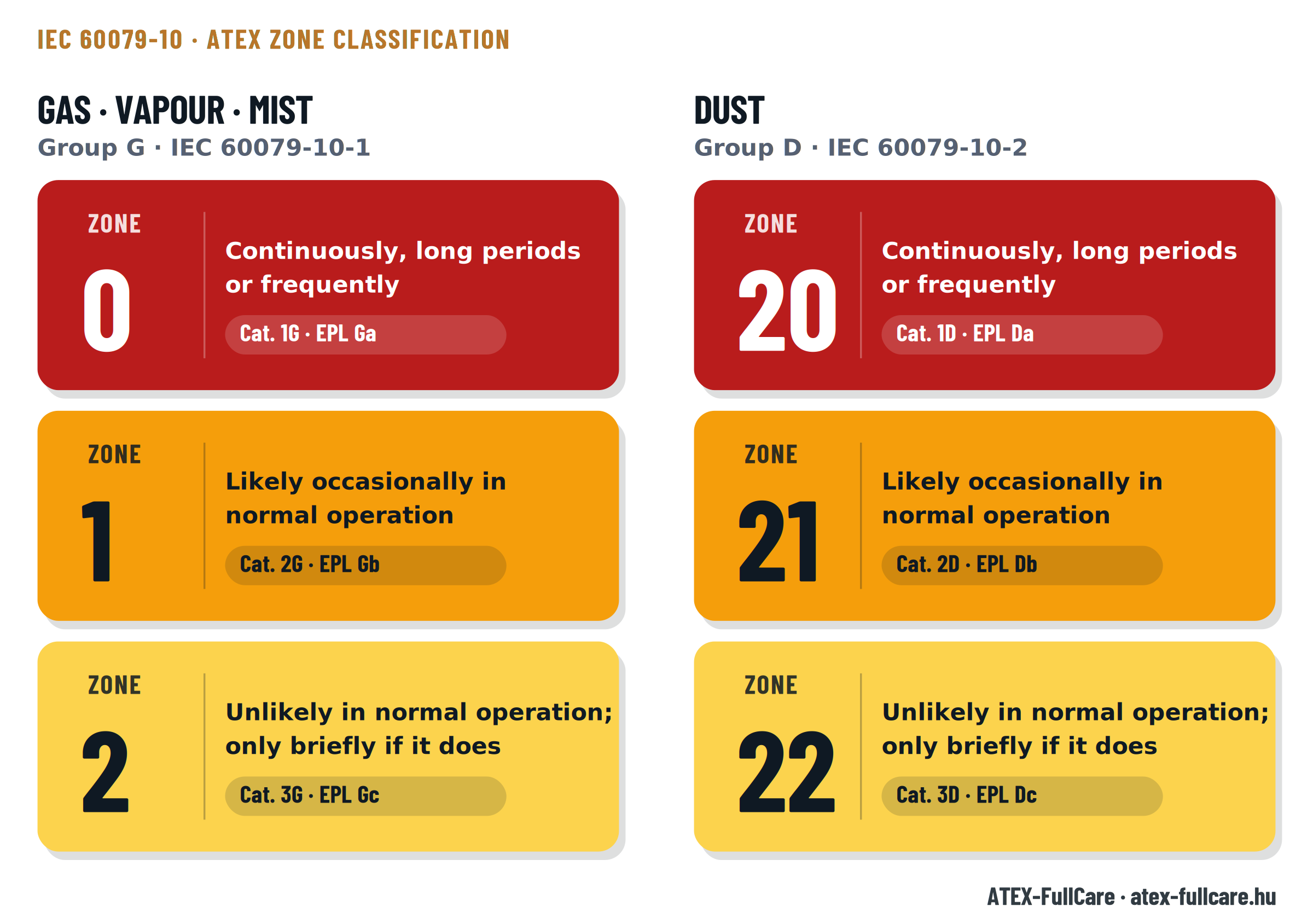
The zone and the equipment category depend on how often gas is present at a given point. The exact determination is the task of ATEX zone classification:
| Location | Main hazard | Zone | Equipment category |
|---|---|---|---|
| Biogas reactor / digester interior | Continuous CH₄ presence | Zone 0 | Category 1G (IIB) |
| Reactor top, vent lines | Emission point | Zone 1 | Category 2G (IIB) |
| Gas collection space, gas-holder bubble | Leakage likely | Zone 1 | Category 2G |
| Pump house, compressor room | Seal leakage | Zone 2 | Category 3G (min.) |
| Sewage manhole, sewer section | CH₄ + H₂S accumulation | Zone 1 | Category 2G (IIB) |
| Separator, gas-cleaning unit | Pressurised gas | Zone 1/2 | Survey-dependent |
| Gas flare area | Transient explosive atmosphere | Zone 2 | Category 3G |
Gas group IIB – equipment selection for methane
Methane belongs to gas group IIB. This means IIA-marked equipment (e.g. general-industrial Ex motors rated for propane) is not suitable in zones containing methane.
Ex motors & pumps
In pump houses and compressor rooms, at least IIB marking is required. T-class: methane's auto-ignition temperature is ~600 °C → T1 is sufficient, but with H₂S present it must be assessed individually.
Ex lighting & switches
In manholes and confined spaces, only IIB- or IIC-marked Ex luminaires and switches may be used. General-industrial IP65 alone is not enough!
Gas & H₂S detectors
Continuous gas monitoring: catalytic LEL sensor (CH₄) and electrochemical H₂S sensor. Sensor placement depends on gas density – upper vs. lower zone.
Cable entries & glands
IIB-rated Ex glands at every cable entry. A missing or incorrect gland is the most common inspection finding at biogas plants.
Most common ATEX faults at biogas and wastewater sites
These are what we find most often – each one is a compliance risk and a potential ground for an insurer to refuse a claim:
- IIA-marked equipment in a IIB (methane) zone – wrong gas group.
- No ATEX zone classification for the manholes and sewer sections.
- General-industrial (non-Ex) pump motors in the pump house.
- Missing continuous gas monitor or an uncalibrated sensor.
- Non-Ex cable junction box in the manhole.
- The confined-space entry procedure is missing from the EPD.
- The zone boundary of the gas holder (floating roof) is not documented.
Biogas and wastewater ATEX inspection – step by step
The on-site survey and documentation follow IEC 60079-17 (inspection) and IEC 60079-10-1 (zone classification):
- Site survey: identifying every CH₄ and H₂S source, and the ventilation conditions.
- Zone classification for the gas and manhole areas (IEC 60079-10-1).
- On-site check of Ex equipment – markings, glands, condition.
- Assessment of the gas-detection system's compliance.
- Preparation or update of the explosion protection document (EPD).
- Photo-documented inspection report with a prioritised defect list.
- ATEX review of the confined-space entry procedure.
Do you have a biogas or wastewater site?
Request a free 30–60 minute online needs assessment. We discuss the technology and your current ATEX/EPD status, and I give you a concrete proposal for the next step.