

ATEX explosion protection for EtO sterilization – the toughest gas, the strictest compliance
Ethylene oxide is the most flammable sterilization medium: explosive from roughly 3% up to practically 100%, and – uniquely – it can explode without air, through self-decomposition. For medical device and pharmaceutical sterilization, ATEX compliance is therefore not an option but a licensing and operating requirement. Hazardous area classification, Explosion Protection Document and Ex inspections per IEC 60079.
Why is EtO unlike any other gas?
For most flammable gases the protection logic is simple: keep the concentration outside the explosive range. With ethylene oxide this logic does not work on its own – and that rewrites every explosion protection decision.
Self-decomposing molecule
EtO can decompose explosively even without oxygen. Nitrogen inertization is a key risk reducer – but on its own it is not full protection.
Extremely wide explosive range
Explosive from about 3% up to practically 100% – hazardous at almost any mixture, with no “safe band”.
Detonation-prone
Deflagration can transition to detonation – which is why blast-resistant structural requirements appear in EtO plants: rated walls and doors.
Carcinogenic
On top of ATEX, occupational exposure and environmental regulations also apply – compliance is multi-layered.
Typical zone classification of the EtO chain
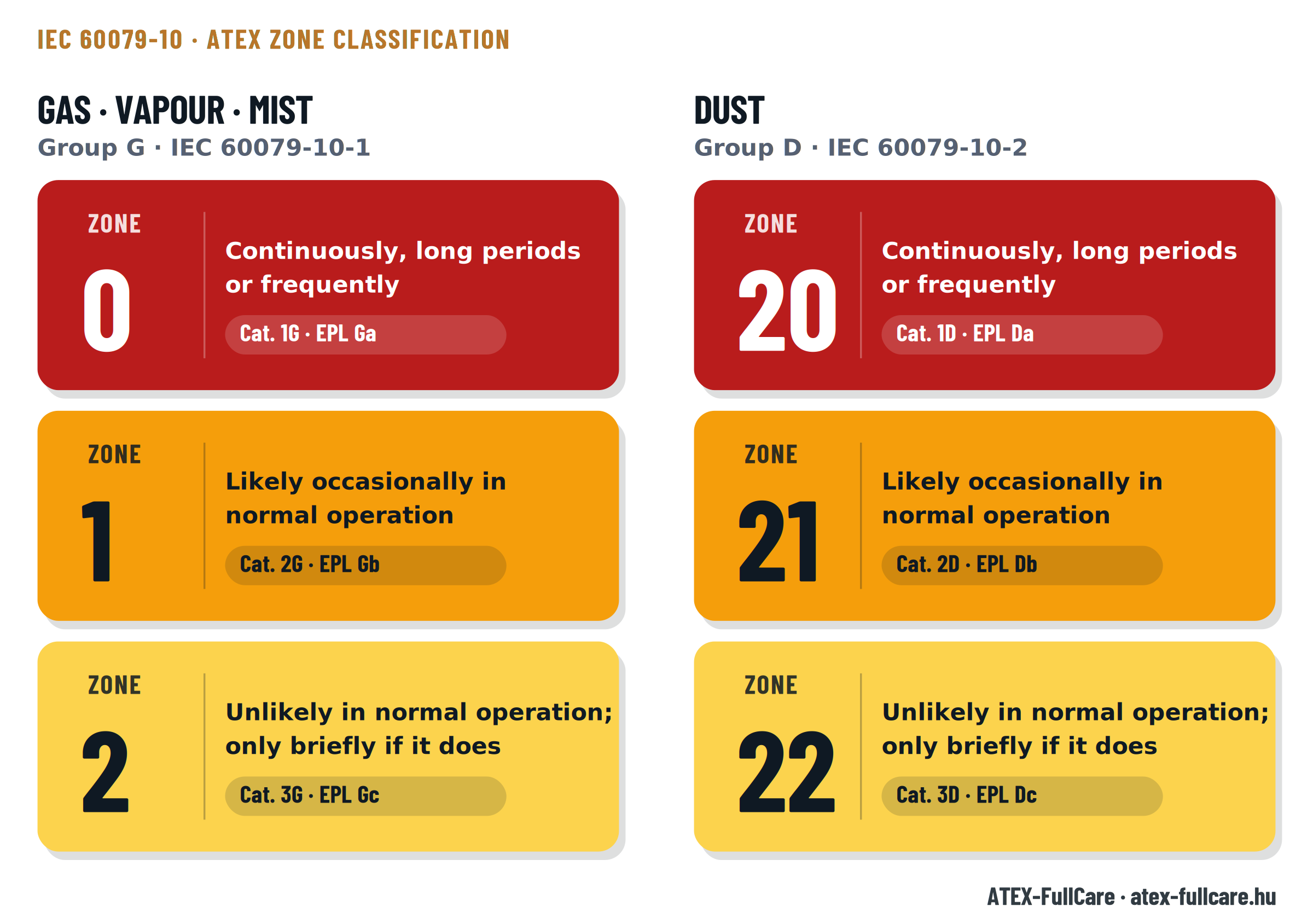
The explosion hazard is not limited to the sterilization chamber – the entire chain must be assessed, from storage to off-gas treatment. The actual classification depends on technology and ventilation, and is documented in the hazardous area classification:
| Process step | Hazard source | Medium | Typical zone |
|---|---|---|---|
| EtO storage (cylinders / tank) | Leakage at connections, unloading | G (IIB) | Zone 2 in the storage room, Zone 1 locally at connections |
| Vaporizer, dosing system | Leaking seals, upset-condition release | G (IIB) | Zone 1 around the equipment |
| Sterilization chamber | EtO injection, door opening, upset conditions | G (IIB) | Zone 1/2 inside, Zone 2 in the chamber room |
| Aeration / degassing room | Residual EtO off-gassing from product | G (IIB) | Zone 2 (depending on ventilation) |
| Vent and abatement system (scrubber, catalytic oxidizer) | Connections, upset-condition release | G (IIB) | Zone 2, locally Zone 1 |
| Sampling and analytical points | Open sampling | G (IIB) | Zone 2, locally Zone 1 |
What does ATEX require in an EtO plant?
Operator obligations are set by Directive 1999/92/EC (ATEX 153, implemented in national law), equipment requirements by Directive 2014/34/EU:
- Hazardous area classification of the entire chain: storage, vaporizer, chamber, aeration, abatement, sampling.
- Explosion Protection Document (EPD) – before first start-up.
- Ex equipment selection: formally IIB T2 is the minimum – in practice often
Ex d/Ex dedesign with margin, due to self-decomposition. - Initial and periodic Ex inspections (IEC 60079-14 / 60079-17), with an Ex equipment register.
- Static electricity control: earthing and bonding of all conductive parts, especially at unloading and filling points.
- Gas detection system: installation, alarm levels, documented calibration and maintenance.
Where ATEX meets other disciplines
EtO plant compliance only comes together when ATEX is managed in coordination with the related disciplines – which are typically owned by different people:
Blast-resistant structures
Due to detonation tendency, walls and doors may be rated for blast overpressure (damage-limiting concept). A structural matter – but it must be managed together with ATEX compliance.
Industrial safety (Seveso)
Depending on the stored EtO quantity, Seveso permitting with a safety report/analysis may also apply – the zone classification and the EPD must be consistent with it.
Fire protection
Fire compartmentation, EI-rated structures, heat and smoke extraction – in a design coordinated with the Ex requirements.
Most common ATEX mistakes in EtO plants
- IIA-marked equipment in an EtO environment (EtO is gas group IIB).
- Inertization treated as full protection – the self-decomposition risk remains unmanaged.
- The aeration room left out of the hazardous area classification.
- No Explosion Protection Document before first start-up – although it is a licensing precondition.
- Missing or undocumented earthing/bonding at unloading and connection points.
- Blast requirements and ATEX compliance run separately, without coordination.
- Gas detector calibration and maintenance not documented.
Operating or building an EtO facility?
Request a free 30–60 minute online assessment. We will go through your technology and your current ATEX status – for plants under design, the concept phase is the cheapest place to get it right.
Request a free assessment30–60 min online consultation